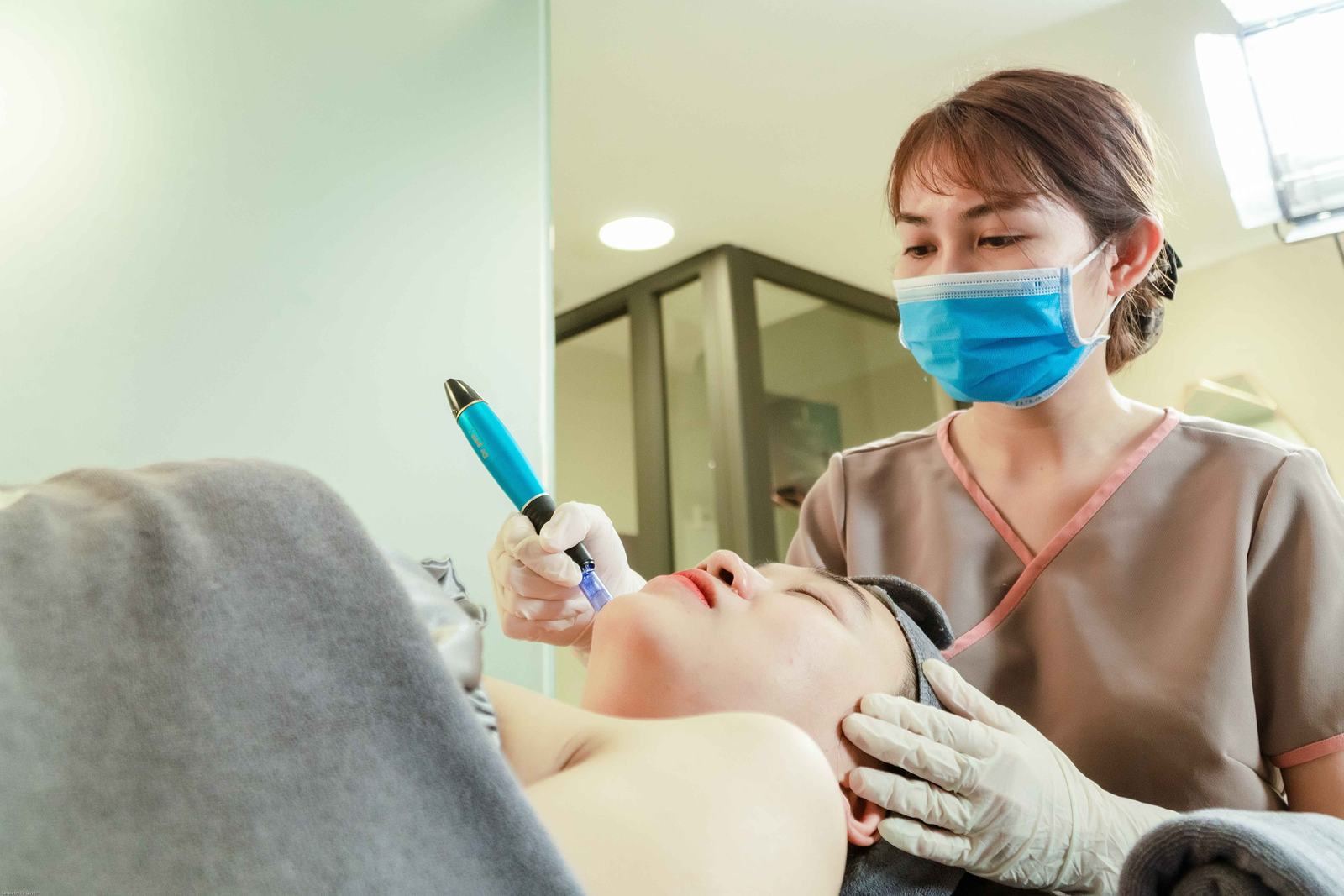
Most people need a series, not one session. Published guidance runs from about three to six sessions, spaced two to eight weeks apart, with the American Academy of Dermatology citing three to five for acne scars and Cleveland Clinic citing two to three for RF microneedling. Collagen keeps building for months, so judge results late.
How many microneedling sessions do you need? Ask five clinics and you will hear five slightly different answers, and most of them will be defensible.
The reason is simple. "Microneedling" covers several treatments, from standard needling to needling paired with your own PRF to radiofrequency (RF) devices, and each has its own typical course. Your concern, how deep it sits and how your skin heals move the number again.
Below you will find the ranges published by the American Academy of Dermatology, Cleveland Clinic and University of Utah Health, why they do not agree, what each approach we offer usually involves, and an estimator that gives you a range with its source attached. Two of its possible answers are "wait" and "you may not need a new series."
How Many Microneedling Sessions Do You Need? What the Sources Say
Most published guidance points to a series of roughly three to six sessions for standard microneedling, with fewer for radiofrequency microneedling. These are ranges, not promises, and each comes with its own spacing.
| Source | Sessions | Spacing | Context |
|---|---|---|---|
| American Academy of Dermatology | 3 to 5 | Every 2 to 4 weeks | Acne scars treated by a dermatologist. Studies found this plan can fade acne scars by 50% to 70%. |
| University of Utah Health | 3 to 6 | 4 to 6 weeks apart | A general plan from an aesthetician, based on skin type and goals. |
| Cleveland Clinic, microneedling | Multiple, no fixed number | About 3 to 8 weeks apart | 3 to 6 months to see results. |
| Cleveland Clinic, RF microneedling | 2 to 3 for most patients; 2 to 4 typically recommended | Not stated | Best results 3 to 6 months after the first treatment. |
| Peer-reviewed review, 2016 | Multiple sittings | 3 to 8 week intervals | New collagen keeps forming for about 3 to 6 months after treatment ends. |
Two things stand out. Every source describes a series, and none presents a single session as the usual plan. The spread in spacing is just as telling, from two weeks at the short end to eight at the long end.
Why Published Ranges Do Not Agree
The ranges differ because the sources describe different treatments, not because someone is wrong. Four things move the number.
- Needle depth and device. Cleveland Clinic notes that needle length on electric devices can run from 0.5 to 2 millimeters, and that longer needles go deeper, which may be needed for deep acne scars. Deeper work usually means more healing time between visits.
- The concern. The AAD's three to five is an acne scar figure from a dermatology setting. A general skin refresh plan from an aesthetician, like the one Utah Health describes, is a different goal.
- Healing speed. Skin needs to recover before the next session. That is why spacing runs from two to eight weeks, and why a longer gap is not a sign that something is wrong.
- The provider's protocol. Clinics build plans around the device they use and how your skin responds, so two good providers can reasonably start you on different schedules.
The practical takeaway is that a number from a website, this one included, is a starting estimate. The plan that matters is the one your provider builds after looking at your skin.
How Many Sessions Does Each Approach Usually Take?
Three approaches come up most often. Hideaway offers two of them, PRF microneedling and Scarlet RF, and your provider helps you choose between them at a consultation.
Standard microneedling
Plan on roughly three to six sessions, a few weeks apart. That is the range Utah Health gives, and it sits comfortably inside the wider picture from the AAD and Cleveland Clinic. It is the baseline the other two approaches build on.
Microneedling with PRF
We found no source that gives PRF its own session count. The AAD describes microneedling combined with platelet-rich plasma, a close relative of PRF made from your own blood, and then gives its general acne scar schedule of three to five treatments. A series of similar length is a reasonable starting expectation. That is our inference, not a published PRF figure, and your provider will refine it. The PRF microneedling page at Hideaway says results build gradually over the weeks after a visit.
One more piece of context, because it shapes the questions worth asking. The FDA's page on microneedling devices says it has authorized specific devices for specific uses, including facial acne scars, facial wrinkles and abdominal scars in people 22 and older. It also says microneedling devices are not approved for delivering blood products such as PRP into the skin, and that the risks of combining devices with other products are not known. That is not a verdict on any one treatment. It is a good reason to ask which device your provider uses and how your plan was built.
RF microneedling (Scarlet RF)
Expect fewer sessions. Cleveland Clinic says most patients receive two to three RF microneedling treatments, that two to four are typically recommended, and that best results usually show three to six months after the first. The Scarlet RF page at Hideaway describes a short series spaced a few weeks apart, with occasional maintenance afterward. Our guide to Scarlet RF vs microneedling covers what the radiofrequency adds.
Fewer sessions does not mean lower stakes. Ask which device will be used and what training your provider has with it. The FAQ below links the FDA's recent safety communication on RF microneedling.
How Many Sessions for Acne Scars, Fine Lines and Texture?
Acne scars
Plan on a series, commonly three to six sessions. The AAD says dermatologist-treated acne scars may take three to five treatments every two to four weeks, and that studies found this plan can fade acne scars by 50% to 70%. Results vary from person to person. Cleveland Clinic lists mild scars from acne or burns among the reasons people consider microneedling, and notes that deeper scars may call for longer needles, which is one reason a provider sets depth and timing for you.
Fine lines, pores and uneven tone
We found no source that gives these concerns their own session count, so the general three to six session range is the best guide available. Keep one distinction in mind. Lines that deepen when you frown or squint come from muscle movement, which is what anti-wrinkle injections relax, while microneedling works on skin quality. Ask which tool fits the lines that bother you.
Loose or crepey skin
Cleveland Clinic lists loose or crepey skin among the reasons people consider microneedling, and says RF treatments are not a replacement for surgery. If sagging is your main worry, ask what a device can realistically do before you commit to a series.
What a Series Looks Like on a Calendar
A course is longer than it first sounds. Four sessions a month apart take about three months, and the collagen window that follows runs for months more.
Illustrative only: four sessions about four weeks apart, then months of building before you judge.
Months from your first session. Spacing and maintenance come from the AAD, Cleveland Clinic and a peer-reviewed review. Your provider sets your own schedule.
Estimate Your Own Series With This Quick Tool
Answer four short questions and the estimator gives you a range with its source attached. It will also tell you plainly when the right answer is to wait, or when you may not need a new series. Nothing you select is saved or sent anywhere.
Session estimator
Pick one answer in each group. The result appears as soon as all four are chosen.
When to Judge Results: Why Session Two Is Too Early
Wait three to six months after your last session before you judge the final result. Cleveland Clinic says it can take three to six months to see results, and the 2016 review in the Indian Dermatology Online Journal says new collagen keeps being laid down for approximately that long after treatment ends. The AAD says you may see improvement within a few weeks, but that it usually takes several months to see full results.
That has a practical consequence. If you feel little change after the second session, treat it as information to share with your provider, not as proof the series failed. A photo in the same light before each visit gives you something better than memory to compare against.
Do You Need Maintenance Sessions?
Probably about one a year once a course ends, if you want to keep the benefit. The AAD says your dermatologist may recommend a maintenance session once a year, and Cleveland Clinic gives the same yearly rhythm. The AAD adds that people lose collagen at different rates, and that protecting your skin from the sun and not smoking can slow that loss.
Maintenance is a choice to make with your provider, not a standing obligation. If your results are holding and you are happy, a check-in may be all you need.
Who Should Check With a Provider First
Certain skin and health conditions are reasons to talk with a provider before starting, and some are reasons to wait. The AAD says microneedling is not for people who:
- Heal slowly or poorly, or have had a raised keloid scar
- Have a weakened immune system because of a condition or a medication
- Are being treated for skin cancer in the area, or are receiving radiation treatments
It also says to wait if you have a tan or recent sun exposure, a skin infection, or painful pimples, and that at least one month should pass after your last isotretinoin pill. Cleveland Clinic adds acne or acne medication, blood disorders or blood thinners, frequent rashes or cold sores, eczema or psoriasis, and moles or growths that change. The FDA's patient guidance also names pregnancy and breastfeeding, clotting disorders and an active rash on the face as reasons a procedure may not suit you, so say so at your consultation.
- Most published guidance describes a series of about three to six sessions, two to eight weeks apart.
- RF microneedling typically takes fewer sessions, about two to three, according to Cleveland Clinic.
- We found no published session count specific to PRF, and no separate number for fine lines, pores or tone.
- New collagen keeps forming for about three to six months after your last session, so judge late.
- Maintenance is usually described as about once a year, and your provider sets your own plan.