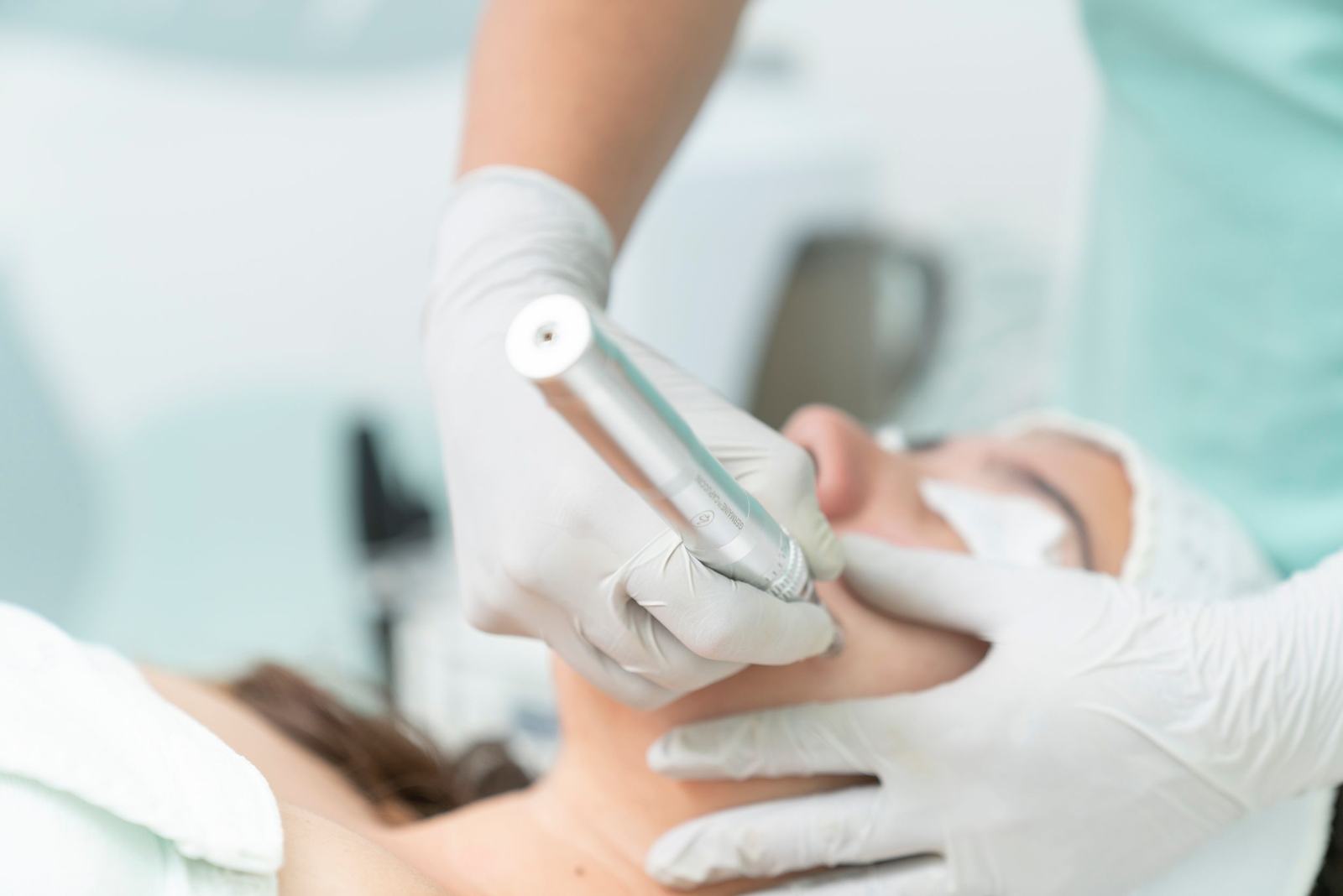
Both start the same way: a small blood draw, a spin in a centrifuge, and your own concentrated healing factors applied to freshly microneedled skin.
The difference comes down to what happens inside that centrifuge, and it is not a marketing distinction. PRP and PRF are genuinely different preparations that behave differently once they are on your face.
Here is what actually separates them, which one suits which concern, and how to judge whether either is worth your money.
The Short Answer
- PRP is platelet rich plasma. It requires an anticoagulant and is spun fast.
- PRF is platelet rich fibrin. No anticoagulant, spun slower, so it forms a fibrin mesh.
- PRP releases its growth factors quickly. PRF releases them gradually over days.
- PRF also captures white blood cells and stem cells that fast spinning leaves behind.
- PRF is generally the better pairing with microneedling. PRP still has real uses.
What Microneedling Does on Its Own
Start here, because the blood component is an enhancement rather than the treatment itself.
Microneedling creates thousands of controlled micro injuries in the skin using very fine needles. Your body responds to that injury the way it responds to any wound, by producing collagen and elastin to repair it. Because the injuries are tiny and precisely controlled, you get the rebuilding response without meaningful damage. Over a series of sessions this improves texture, softens fine lines, refines pores and helps acne scarring.
Those same micro channels do something else useful. For a short window after treatment the skin is far more permeable than usual, which means anything applied immediately afterward penetrates much more effectively than it ever would on intact skin. That window is the entire reason for pairing microneedling with PRP or PRF.
It is also the reason you should be careful about what gets applied. Ordinary serums containing fragrance, acids or vitamin C are not designed to enter the skin through open channels and can cause irritation or worse. This is why reputable clinics apply only sterile, appropriate products during the procedure.
How PRP and PRF Are Actually Made
Both begin with a routine blood draw from your arm, usually a small amount, no different from a standard blood test.
For PRP, the blood goes into a tube containing an anticoagulant to prevent clotting, then spins at high speed. The high speed separation produces a liquid plasma concentrated in platelets, which carry growth factors. Because it stays liquid, it can be injected easily or spread across the skin.
For PRF, the blood goes into a tube with no anticoagulant and spins more slowly. Without an anticoagulant, natural clotting begins, and fibrin, the protein scaffold your body uses in wound healing, forms a soft mesh. That mesh traps platelets, growth factors, white blood cells and a population of stem cells within it.
The slower spin matters for a second reason. High speed centrifugation separates efficiently but leaves behind some of the white blood cells and stem cells that a gentler spin retains. PRF therefore contains a broader mix of the cells involved in tissue repair, not just a higher platelet count.
Head to Head
| Factor | PRF | PRP |
|---|---|---|
| Anticoagulant | None | Required |
| Spin speed | Slower | Faster |
| Consistency | Soft fibrin gel | Liquid |
| Growth factor release | Gradual, over about a week | Rapid burst |
| Cells retained | Platelets, white blood cells, stem cells | Mainly platelets |
| Best paired use | Microneedling, under eye hollows, overall rejuvenation | Scalp treatment, situations needing an easily injected liquid |
| Additives | Nothing but your own blood | Your blood plus an anticoagulant |
Which One Should You Choose?
For microneedling specifically, PRF is usually the stronger pairing. The sustained release lines up well with the timeline of collagen remodeling, which unfolds over weeks rather than hours, and the additional cell types support that process. The fact that it contains no additive at all appeals to a lot of people too.
PRP is not obsolete. Its liquid consistency makes it easy to distribute and inject precisely, which is why it remains widely used for scalp treatment in hair restoration, and it has the longer research history of the two. Where a thin, easily spread liquid is the practical requirement, PRP still makes sense.
An honest caveat: the research comparing PRF and PRP head to head in aesthetics is still developing, and much of the enthusiasm for PRF is based on its biological rationale plus clinical experience rather than a deep body of large trials. The mechanism is sound and the results clinicians report are consistent, but anyone presenting PRF as definitively proven superior is ahead of the evidence.
What It Treats Best
PRF microneedling is not a general purpose fix, and knowing where it genuinely earns its place makes the decision easier.
It performs well on overall skin quality: dullness, uneven texture, enlarged pores and early fine lines. The combination of collagen stimulation and concentrated healing factors tends to produce a result people describe as looking rested rather than looking treated, which is exactly what most patients want.
Acne scarring is one of its strongest indications, particularly rolling and boxcar scars where the issue is tethered or depressed tissue rather than pigment. Improvement here is real but gradual, and it takes a committed series rather than a couple of sessions.
Under eye hollowing and crepey lower lid skin are another common target, and this is where PRF is often injected rather than only applied topically. The area is delicate and traditionally difficult to treat, since firm filler placed badly under the eye creates problems of its own. A soft, purely autologous material that improves tissue quality rather than adding structure suits the region well.
What it does not do is tighten meaningful laxity or correct pigmentation. For genuine sagging along the jawline, radiofrequency reaches deeper and does more. For melasma or sun damage, the answer lies in a different category of treatment entirely. The American Academy of Dermatology's overview of wrinkle treatments is a helpful grounding on what each category realistically achieves.
What the Appointment Involves
Expect around ninety minutes in total. Numbing cream goes on first and needs roughly half an hour to work properly, and rushing that step is the main reason people find microneedling uncomfortable.
Your blood is drawn while the numbing takes effect, then spun while your skin is prepped. The microneedling pass itself takes fifteen to twenty minutes, with depth adjusted by area, and most people describe it as a strong vibrating sensation rather than sharp pain. The PRF is then applied across the treated skin, and often injected into specific areas such as under eye hollows where it does additional work.
One point people find reassuring: because the material is made from your own blood, there is no question of allergic reaction to a foreign substance and nothing synthetic is being introduced. That is a genuine advantage of this category of treatment rather than a marketing line.
You leave looking noticeably red, similar to a moderate sunburn. That settles substantially within twenty four to forty eight hours. Expect some tightness and mild flaking around days two to four as the surface renews.
Aftercare and Results Timeline
The first day matters most. Leave the skin alone, use only what your provider gives you, and skip makeup for at least the rest of the day so those open channels can close. Avoid the gym, saunas, hot showers and swimming for about forty eight hours, since heat and sweat on freshly needled skin invite irritation. No active ingredients such as retinoids, acids or vitamin C for several days, and rigorous sun protection for at least a week.
Results arrive in two waves. There is an early glow within about a week as swelling settles and surface renewal completes. The real change, in texture, firmness and scarring, builds over four to twelve weeks as new collagen forms, and it continues improving well after the appointment is a memory.
A practical note on photographs. The change from a treatment like this is gradual enough that you acclimatize to it, and people routinely underestimate their own progress. Take a clear photo in consistent lighting, without makeup, before your first session and again before each subsequent one. Comparing week twelve to memory is unreliable. Comparing it to an actual image is not.
Most concerns need a series rather than a single session, commonly three to six treatments spaced roughly four to six weeks apart, with acne scarring at the higher end. Booking one session and judging the outcome is the most common way people conclude the treatment did not work.
If you want to know whether your skin is a sensible candidate, our PRF microneedling consultations in Peculiar start with an assessment of what you are actually trying to change and whether a different approach would serve you better. We also offer radiofrequency microneedling, which addresses laxity in a way standard microneedling does not. Patients travel to us from Raymore, Belton and Harrisonville, and you are welcome to ask questions first.